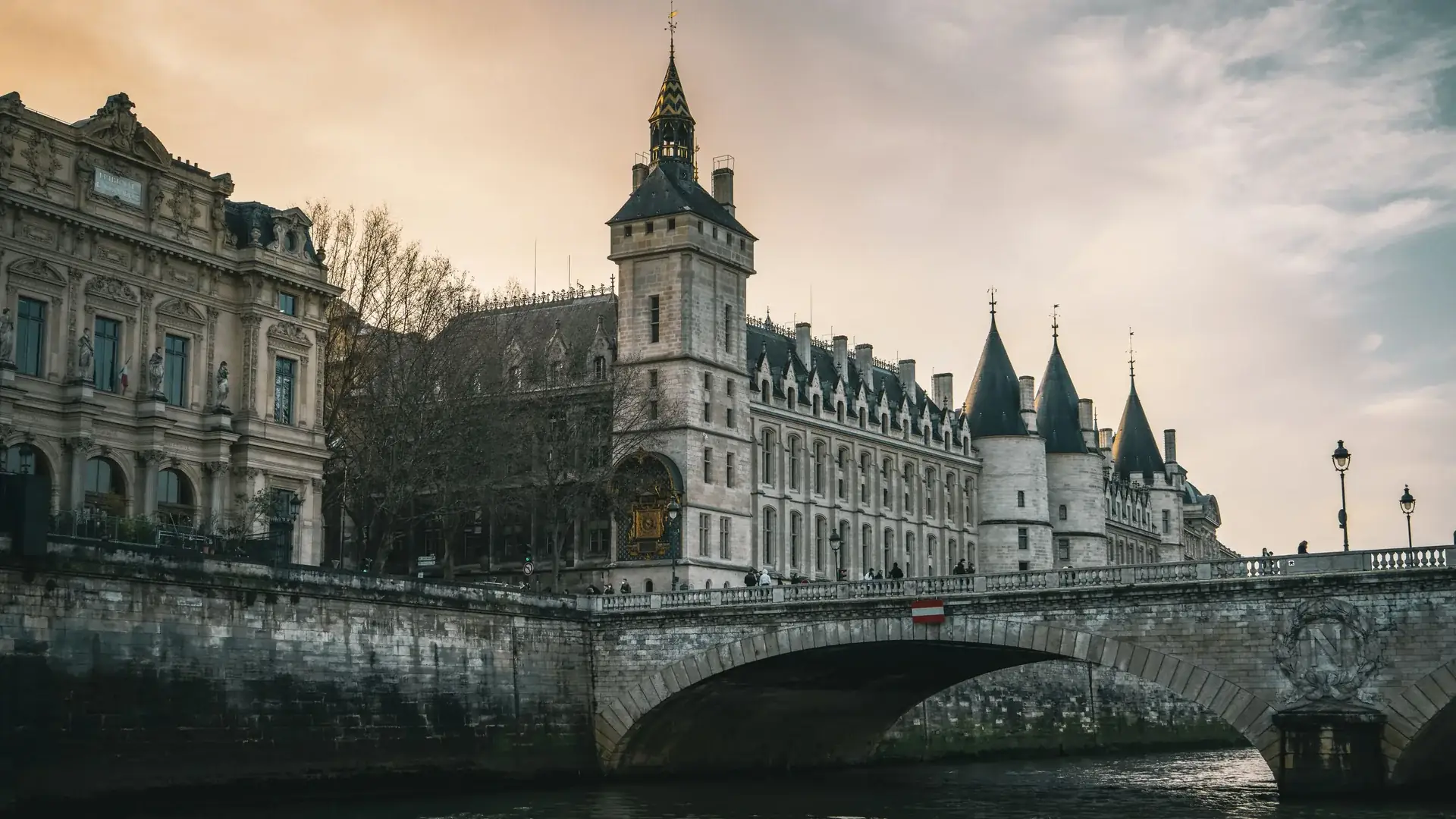
Palace, then prison, then museum
Three lives in one building, each one leaving something the next couldn't remove.
- 1300s
The king's hall on the island
Philip the Fair's masons raised the Salle des Gens d'Armes as the dining hall of the Palais de la Cité's guards and servants — at roughly sixty-one by twenty-eight metres, described as the largest non-religious Gothic hall in Europe. The riverfront clock tower, the Tour de l'Horloge, followed around 1350 under John II, and the kitchens a few years later.
- 1793–1795
The antechamber of the guillotine
From 1793 the Revolutionary Tribunal sat in the palace's Grand Chamber, upstairs, and before it was abolished on 31 May 1795 it sentenced some 2,780 people to death. Marie-Antoinette was brought here on the night of 1–2 August 1793 and executed on 16 October; Robespierre was held here before his own execution in July 1794.
- 1914 to today
From working prison to national museum
Some sections opened to visitors in 1914, but the prison kept running until 1934. The building is now a national monument, with a Hall of Names listing more than 4,000 people tried by the Revolutionary Tribunal, and a HistoPad tablet that rebuilds both of its earlier lives in 3D.
Every visitor passes an X-ray bag check at the door — bulky bags, knives and glass bottles are refused, so travel light.
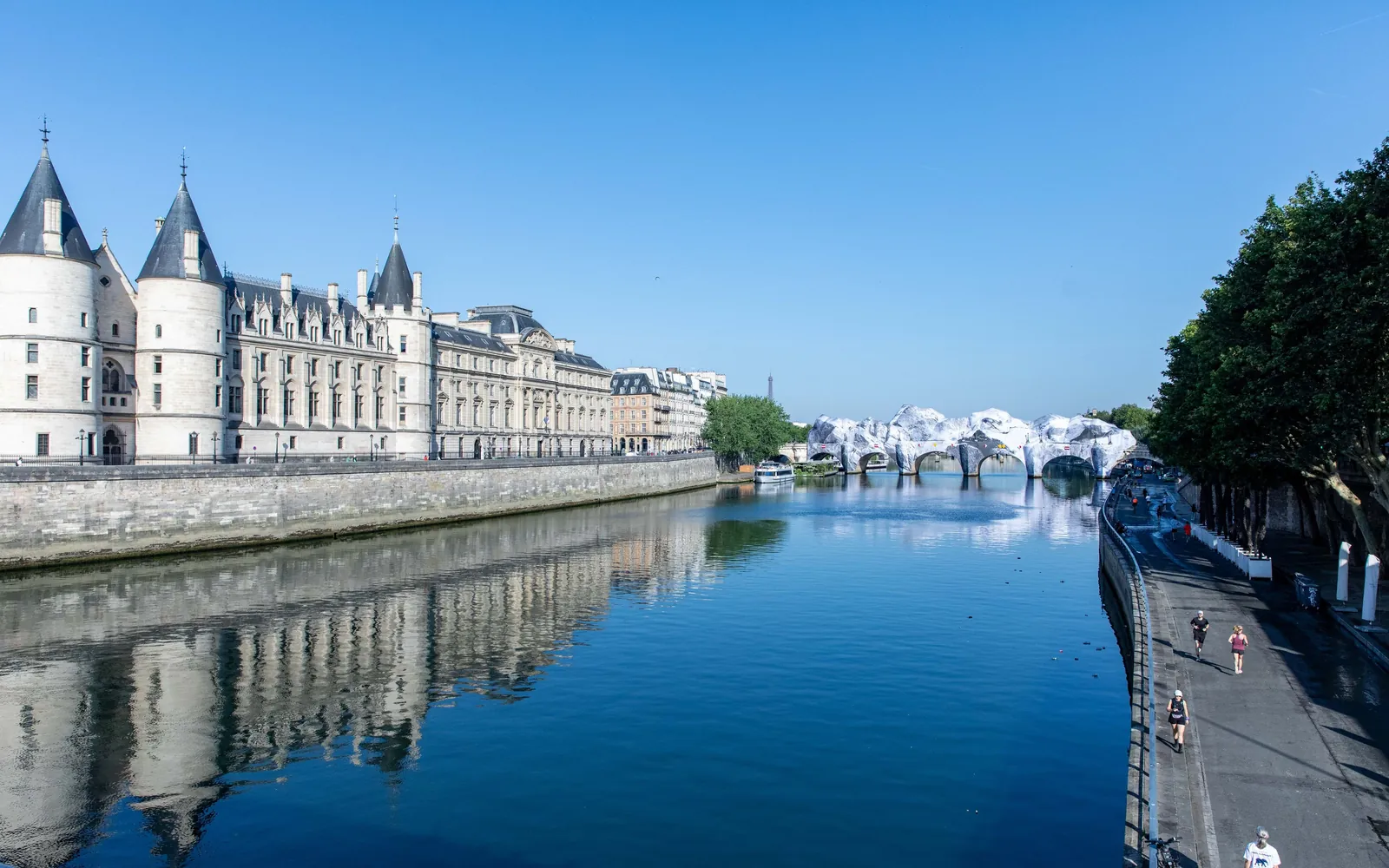
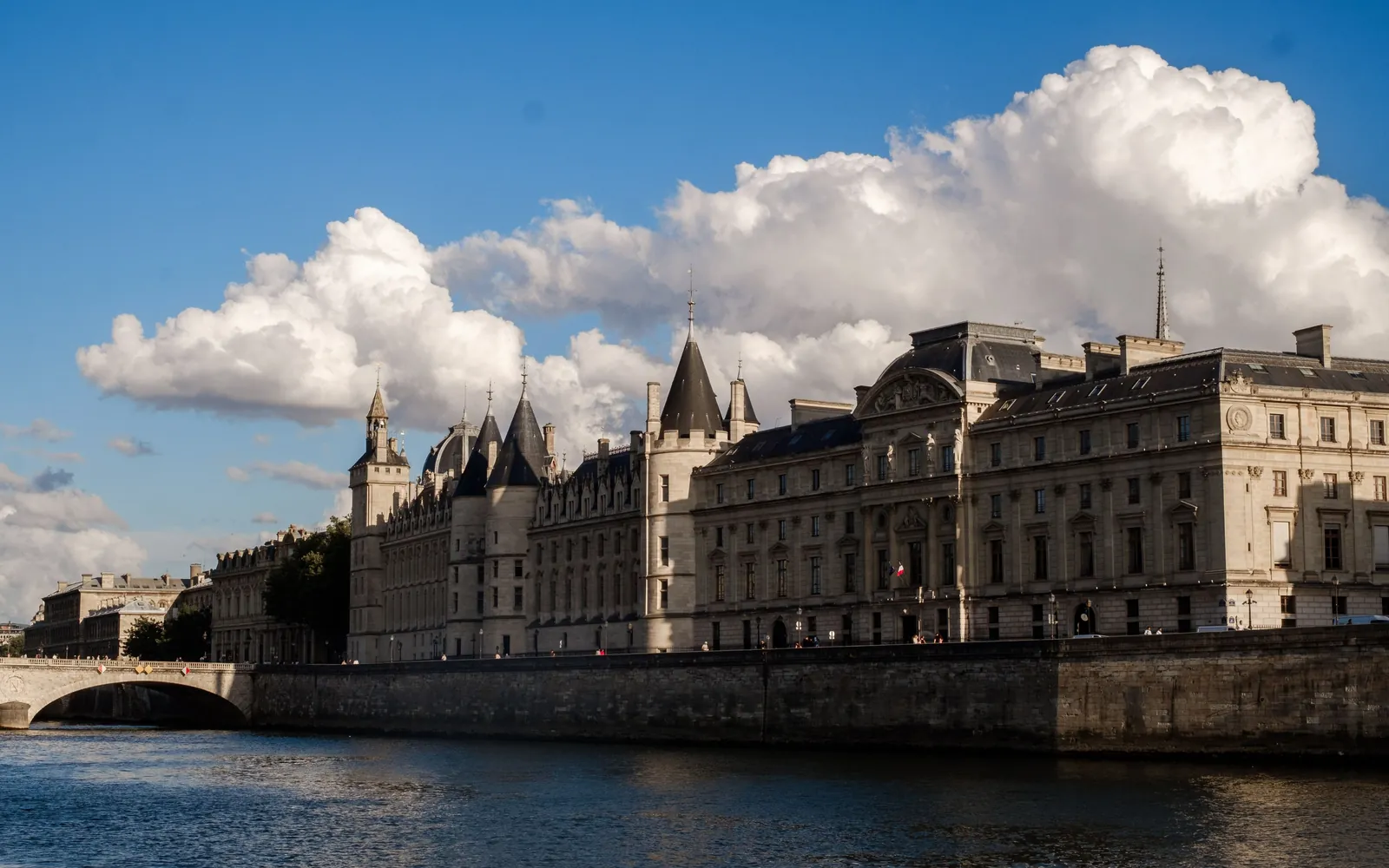
What's actually there, and what's since become story
A hall built for a palace's staff
Philip the Fair's masons raised the Salle des Gens d'Armes in the early 14th century — about sixty-one metres long and twenty-eight wide, and described as the largest non-religious Gothic hall in Europe. It served as the dining hall and gathering place for the palace's guards and servants, reckoned at between one and two thousand people.
The HistoPad is the building's own feature, not a Viator extra
The tablet visitors pick up at the entrance, built by Histovery, layers 360-degree reconstructions of the 14th-century palace under Philip the Fair and of prison life during the Revolution onto the bare stone rooms, with a treasure-hunt mode for families. It's part of the monument's own visit, not something Viator or this guide supplies.
The clock tower predates the clock
The riverfront tower now called the Tour de l'Horloge was finished around 1350 under John II; the clock that gave Paris its first public timepiece was added later, under Charles V, by the clockmaker Henri de Vic.
Security comes with the law courts next door
The Conciergerie is part of the Palais de Justice complex, so entry means an X-ray bag check — the monument's own list of refused items includes knives and sharp objects, glass bottles, aerosols, motorbike helmets and bulky bags, and pushchairs must be small and foldable. Budget extra time for it.
What the visit actually covers
One ticket, one route, two eras layered on top of each other.
The Salle des Gens d'Armes and the royal kitchens
The great hall and the kitchens added around 1353, built on two levels to cook for the royal family above and the palace staff below — clear evidence of how large the Palais de la Cité's household really was.
The prison galleries and the Cour des Femmes
The route through the prison galleries, reconstructed cells and the women's courtyard, where Marie-Antoinette and other women prisoners were allowed to exercise, carries the building's weight more than any single caption does.
The Marie-Antoinette rooms
The site of her second cell, where she spent her last 44 days, is now a memorial chapel commissioned by Louis XVIII after the Bourbon Restoration; its only light comes from a single stained-glass window.
The Hall of Names
A memorial room listing more than 4,000 people tried by the Revolutionary Tribunal between 1793 and 1795, whatever their verdict — a plain, long list that tends to land harder than the grander rooms around it.
Ways to see it
| Way to see it | What it covers | Suits |
|---|---|---|
| La Conciergerie on its own | The great hall, the HistoPad route and the Marie-Antoinette rooms | A tight Paris morning with one stop to spare |
| Sainte-Chapelle and Conciergerie, guided | Both monuments walked together with a guide, booked on Viator | A first visit, when the story matters as much as the stone |
| Sainte-Chapelle and Conciergerie, self-paced | The same two buildings at your own speed, without a guide | Repeat visitors, or anyone short on time |
| The Île de la Cité on foot | Conciergerie, Sainte-Chapelle and Notre-Dame strung together along the river | A full morning rather than a single stop |
Getting there and getting in
Métro Cité is the direct route
Line 4 stops at Cité, a short walk from the entrance at 2 Boulevard du Palais — the simplest approach from most of central Paris.
Châtelet and Saint-Michel as alternatives
Châtelet links lines 1, 7, 11 and 14 and sits a few minutes away across the Pont au Change; the RER B and C stop at Saint-Michel, a similar walk from the Left Bank.
Budget time for the bag check
Every visitor passes an X-ray bag check at the entrance — this adds more to a visit than most people plan for.
On foot from the rest of the island
Sainte-Chapelle is a couple of minutes away along the Boulevard du Palais and Notre-Dame under ten minutes on foot; the Île de la Cité is flat and compact enough to walk end to end.
Guides to the building and its two lives
Her final weeks
Marie-Antoinette at the Conciergerie
What's documented about her transfer, her two cells and the chapel built on the site — and what's since become legend.
Read the guide →The tablet
The HistoPad: what it actually shows
What the tablet reconstructs, which two eras it covers, and how families use it.
Read the guide →Pairing the two
The Conciergerie and Sainte-Chapelle in half a day
Two halves of the same medieval palace, barely two minutes apart — how to see both without wasting the morning.
Read the guide →From palace to prison
The Conciergerie: from royal palace to revolutionary prison
How a 14th-century royal hall ended up as the Revolution's most feared address.
Read the guide →Visiting with the Revolution in mind
Visiting the Conciergerie with the Revolution in mind
A route through the building for anyone whose main reason for coming is 1793, not 1313.
Read the guide →Getting there
How to get to the Conciergerie
Métro, RER and on foot across the Île de la Cité — plus the one delay that catches people out.
Read the guide →Questions readers ask
Does this page sell tickets for La Conciergerie?
No — the Centre des monuments nationaux manages La Conciergerie and sets its own admission and hours. This page is written independently of it, and every tour linked here routes through Viator. See the monument's own website.
Where does the HistoPad tablet come from?
Visitors pick it up at the monument's entrance. It's part of the monument's own visit, developed by Histovery — not a Viator add-on or something this guide arranges.
What is the Salle des Gens d'Armes?
The great medieval hall at the heart of the building — raised in the early 14th century under Philip the Fair, about sixty-one by twenty-eight metres, and described as the largest non-religious Gothic hall in Europe. It was the dining hall for the palace's guards and servants.
How long was Marie-Antoinette held at the Conciergerie?
About eleven weeks. She was transferred from the Temple prison on the night of 1–2 August 1793 and executed on 16 October; the last 44 days were spent in the cell whose site is now the memorial chapel.
Can I combine this with Sainte-Chapelle?
Yes. The two buildings are a couple of minutes apart on the Boulevard du Palais. There's also a guided tour covering both; the monuments' own websites cover entry if you'd rather go at your own pace.
Is the Conciergerie wheelchair accessible?
No — the monument's own practical information states that it is not equipped with access for visitors with reduced mobility.
Who gets in free?
According to the monument's own site, under-18s enter free, as do 18–25-year-olds who are EU nationals or regular residents of France, and disabled visitors with one companion. Check the monument's website for the full list before you go. See the monument's own website.
How do I get to the Conciergerie?
Métro Cité on line 4 is closest; Châtelet (lines 1, 7, 11, 14) and Saint-Michel (RER B, C) are a short walk across the bridges. Allow extra time for the X-ray bag check at the entrance.